Practical ways early childhood educators can build wellbeing, confidence and movement skills through play
In early childhood, movement is not “extra”. It is one of the ways children learn about their bodies, their emotions, their friendships, their environment and what they are capable of doing.
This is why movement sits so naturally within EYLF Outcome 3: Children have a strong sense of wellbeing. The Early Years Learning Framework recognises wellbeing as both physical and psychological. It includes physical health, fitness, activity, feelings of satisfaction, successful social functioning, and children’s growing confidence to engage with the world around them. [1]
For Australian kindergartens, preschools and early childhood education centres, animal-inspired movement offers a simple, joyful and highly practical way to support this outcome. Children are not just “pretending to be animals”. They are building balance, coordination, body awareness, strength, self-regulation, social confidence and participation through play.
That is exactly where Animal Fun fits.
Animal Fun is a movement program for children aged 3–6 years that supports fine motor skills, gross motor skills and social skills. It was designed by physiotherapists, occupational therapists and psychologists from Curtin University’s Health Sciences Faculty, with animal movements matched to foundation developmental skills. [3]
The result is a play-based approach that feels natural for young children and practical for educators.
Why EYLF Outcome 3 and movement belong together
Outcome 3 focuses on children developing a strong sense of wellbeing. This includes social, emotional, mental and physical wellbeing.
The EYLF specifically describes physical wellbeing as contributing to children’s ability to concentrate, cooperate and learn. It also recognises that physically active play, fine motor skills, gross motor skills and fundamental movement skills provide important foundations for children’s independence, physical skill and satisfaction in being able to do things for themselves. [1]
In everyday practice, this means movement can support wellbeing when children:
- build strength, coordination and stamina
- develop gross motor and fine motor control
- explore indoor and outdoor spaces safely
- participate in active play, dance, drama and games
- practise turn-taking, cooperation and social connection
- take considered risks in safe, supported environments
- learn strategies to calm, reset and regulate their bodies
This is not separate from learning. It is part of learning.
A child who can balance, crawl, climb, hop, throw, catch, manipulate tools, orient themselves in space and participate confidently in group play is developing more than physical ability. They are also building confidence, agency, persistence, problem-solving and connection with others.
Why animals work so well for young children
Animal-inspired movement works because it taps into something children already love: imagination.
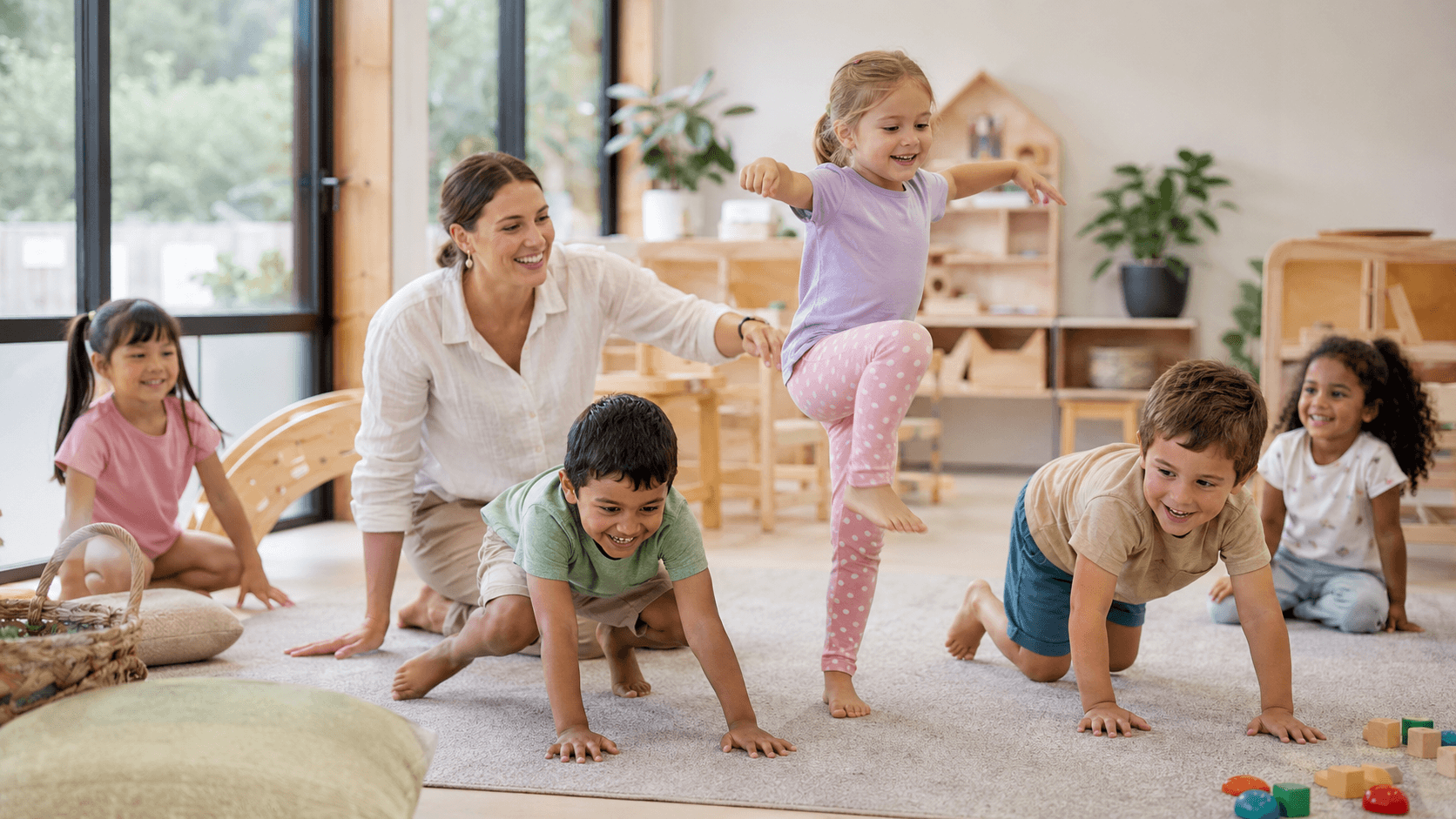
When children are invited to jump like a kangaroo, crawl like a bear, balance like a flamingo or curl up into a ball like an armadillo, they are not being asked to complete a formal exercise. They are entering a story.
This matters because pretend play lowers the barrier to participation. Children who may be hesitant, shy, uncoordinated or unsure of their abilities often find it easier to join in when the movement is playful, familiar and imaginative.
Animal Fun was developed around this idea. The program recognises that many children in this age group love animals and pretend play, so foundation movement skills are paired with animal movements to make practice engaging and meaningful. [3]
For educators, this makes movement easier to embed into the day. A two-minute “flamingo balance” before mat time, a “bear crawl” transition to the outdoor area, or a armadillo shaking off ants as a reset after lunch can all contribute to Outcome 3 without needing expensive equipment or a separate physical education lesson.
How animal-inspired movement supports physical learning and wellbeing
One of the key parts of Outcome 3 is that children become strong in their physical learning and wellbeing.
Animal-inspired movement can support this in several practical ways.
1. Balance and postural control
Balance is a foundation for many early childhood skills. A child needs balance to climb, run, jump, sit upright, dress themselves, move safely around the playground and participate in active games.
Animal examples:
- Flamingo stands: standing on one leg to build single-leg balance and body awareness
- Penguin walks: taking small controlled steps to practise stability
- Giraffe reaches: stretching tall to encourage posture, reach and controlled movement
These activities help children feel more secure in their bodies and more confident navigating different spaces.
2. Core strength and coordination
Core strength helps children sit, move, climb, crawl, draw, cut, dress and play. It also supports coordination between the upper and lower body.
Animal examples:
- Bear crawls: building shoulder stability, trunk strength and cross-body coordination
- Crab walks: strengthening arms, legs and trunk while challenging coordination
- Snake slithers: developing body awareness and upper body control
These movements are playful, but they are also purposeful. They encourage children to organise their bodies in different positions, which supports both gross motor and fine motor development.
3. Locomotion and fundamental movement skills
Children need repeated opportunities to practise moving in different ways. Hopping, jumping, crawling, running, climbing, throwing and kicking all contribute to fundamental movement development.
Animal examples:
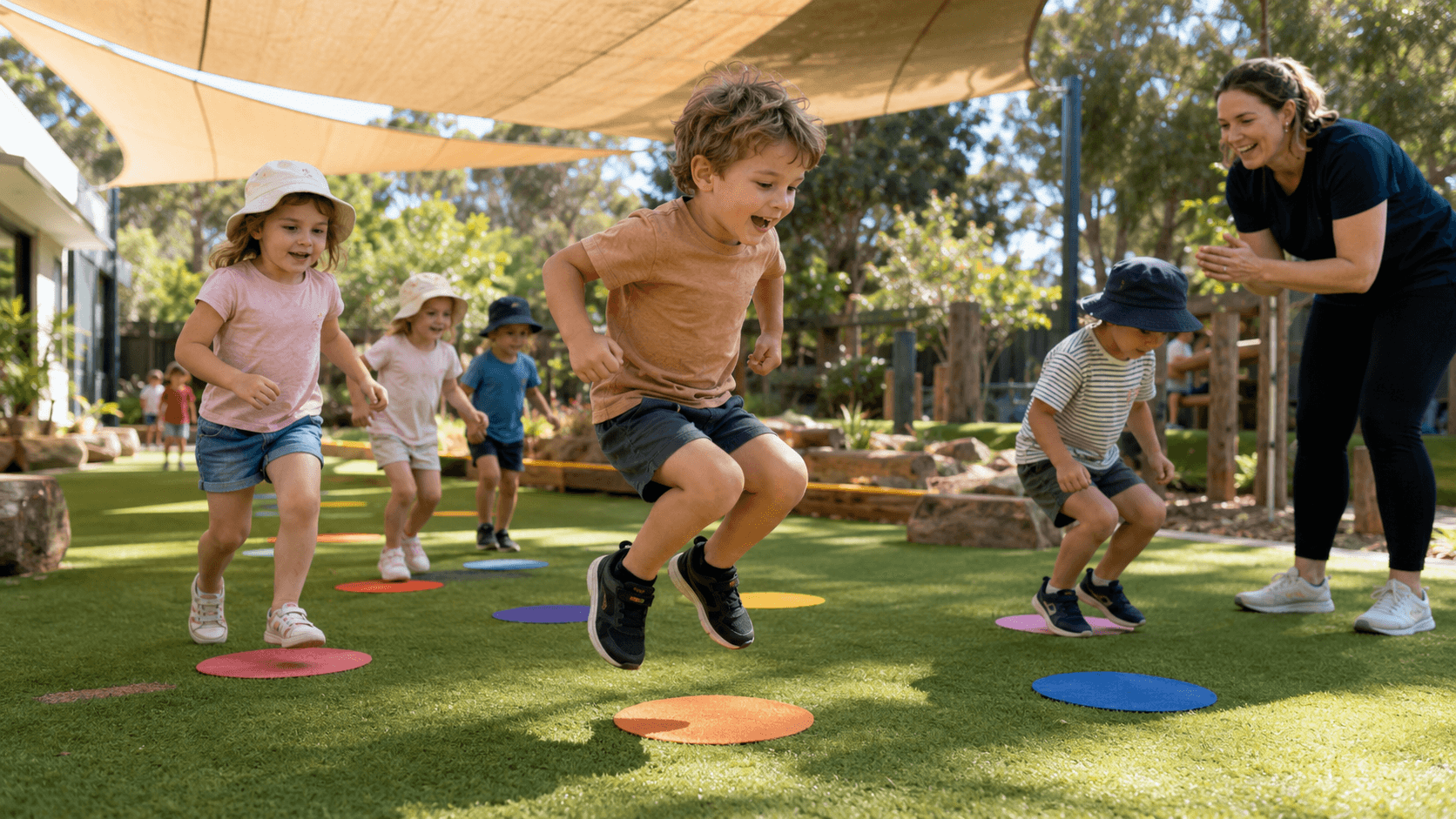
- Kangaroo jumps: jumping and landing with control
- Frog jumps: two-foot take-off and landing
- Bear walking: same side synchronised on hands and feet gets heart rate up quickly
- Monkey movements: swinging, reaching or climbing variations where safe and appropriate
The EYLF encourages educators to plan for energetic physical activity, including fundamental movement skills and games. [2] Animal-inspired movement gives educators an easy way to do this in a format children understand and enjoy.
4. Spatial awareness and safe movement
Young children are still learning how their bodies move through space. They need practice moving around, over, under, through and beside people and objects.
Animal examples:
- “Crawl like a crocodile around the river”
- “Jump like a frog between the lily pads”
- “Walk like a possum along a log””
- “Skip like a brolga without bumping wings with another brolga”
These simple prompts help children practise body awareness, direction, speed control and safety around others.
How animal-inspired movement supports social and emotional wellbeing
Outcome 3 is not only about physical health. It also includes social, emotional and mental wellbeing.
Group movement activities give children repeated opportunities to practise:
- joining in
- waiting for a turn
- copying others
- leading others
- managing excitement
- coping when something feels hard
- celebrating effort and progress
- noticing how their body feels before and after movement
For example, a group game of “ants working hard together” can encourage cooperation. “Meerkats” can help children learn about taking care of others. “Friendly rabbits” can invite gentle partner or group interaction.
This links strongly with the EYLF’s emphasis on children building emotional regulation, cooperating with others, accepting challenges, taking considered risks and celebrating their own efforts and achievements. [2]
Movement also gives educators a powerful observation window. During an animal movement game, educators may notice who is confident, who avoids physical play, who has difficulty coordinating movements, who struggles with turn-taking, who leads others, and who needs extra support to feel included.
How this supports Australian physical activity guidelines
The World Health Organisation Activty guidelines, which are supported by Australian Health Departments recommend that preschoolers aged 3–5 years are active for at least three hours each day, including one hour of energetic play. This activity should be spread throughout the day and should be fun, exploratory and active. [5]
That can sound like a lot when educators are already managing routines, transitions, documentation, group times, meals, rest, behaviour support and learning experiences.
The advantage of animal-inspired movement is that it can be woven into what is already happening.
For example:
- 2 minutes of kangaroo jumps before outdoor play
- 3 minutes of armadillo then cobra if children are restless and fidgety
- 5 minutes of animal walks during transition time
- 10 minutes of obstacle course play outside
- 2 minutes of penguin walking or slow elephants for routines such as visits to the bathroom
- 5 minutes of bear crawls, frog jumps and flamingo balances on a rainy day
These small moments add up. They also make movement feel like a natural part of the daily rhythm rather than another task on the program.
Animal Fun’s own educator information highlights that the program is designed to be easy to implement, flexible, evidence based, and able to be embedded into existing curriculum rather than adding stress to the workload. [4]
What makes Animal Fun a useful fit for EYLF Outcome 3?
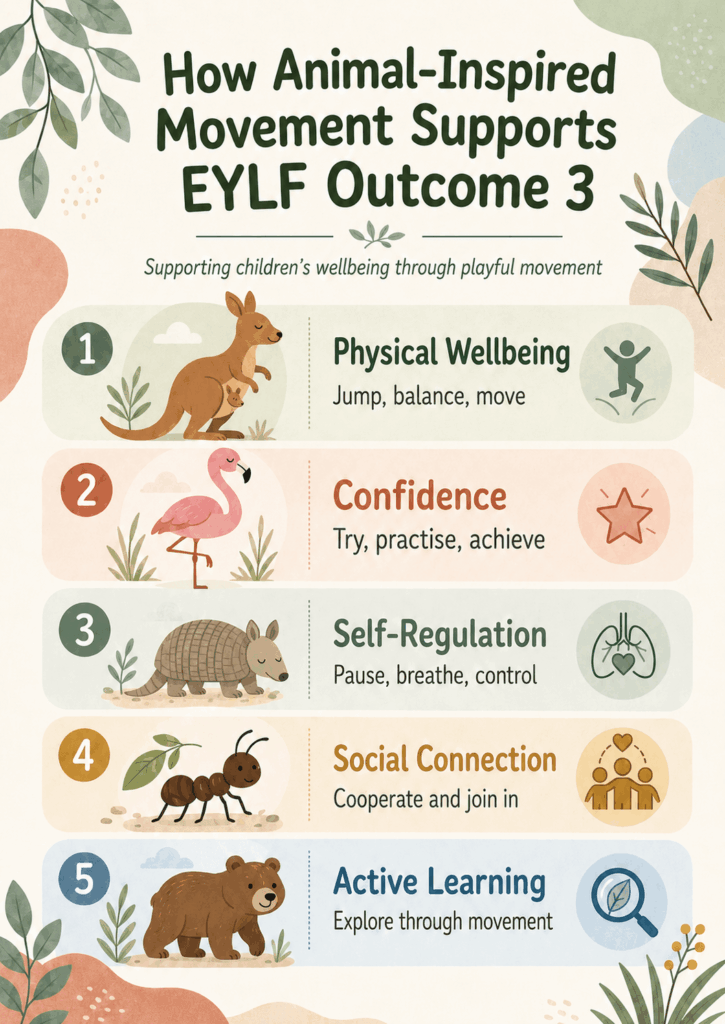
Animal Fun is particularly well matched to Outcome 3 because it brings together three things educators need:
1. It is play-based
Children participate through imagination, imitation and active play. This aligns with how young children learn best.
2. It is developmental
The program focuses on foundation skills that help children become more competent and confident in active play and early learning.
3. It is practical for educators
Animal Fun can be used as structured learning or embedded into everyday routines, transitions, mat time, indoor play and outdoor play. The program does not require expensive equipment and is designed to be engaging for children. [4]
Animal Fun’s research background also gives educators confidence that the program is more than a collection of fun activities. A Healthway-funded 3-year randomised controlled trial found that children who participated in Animal Fun for 10 weeks showed significant improvements in motor ability and social-emotional development, with a significant decrease in hyperactive and inattentive behaviours compared with children in control schools. [6]
Practical examples: linking animal movements to Outcome 3
Here are some simple examples educators can use when planning or documenting learning.
Kangaroo jumps
Movement focus: jumping, landing, leg strength, coordination
Wellbeing link: confidence, energetic play, persistence
Possible observation: “The children practised jumping and landing with control. Several children showed increasing confidence to try again after losing balance.”
Flamingo balance
Movement focus: single-leg balance, postural control, body awareness
Wellbeing link: concentration, self-regulation, challenge
Possible observation: “Children explored balance by standing like flamingos. They noticed how their bodies wobbled and used their arms to help stay steady.”
Bear walk
Movement focus: core strength, shoulder stability, same side synchronised movement pattern
Wellbeing link: effort, stamina, body confidence
Possible observation: “Children moved through the space using hands and feet, developing strength, coordination and awareness of others around them.”
Armadillo
Movement focus: slow body movement, core strength, grounding and calming
Wellbeing link: self-regulation, emotional awareness
Possible observation: “Children curled into a ball and rocked on their spines and practised slow breathing to help calm their bodies after active play.”
Ants working together
Movement focus: group movement, coordination, teamwork
Wellbeing link: cooperation, social connection, turn-taking
Possible observation: “Children worked together to move like ants, passing objects to each other over head, taking turns, following group cues and helping each other stay involved.”
Documentation language educators can use
Animal-inspired movement can be documented in simple, EYLF-aligned language.
Examples:
“Children participated in animal-inspired movement play to support gross motor development, coordination, balance and confidence.”
“Children practised moving safely through the indoor/outdoor environment, demonstrating growing spatial awareness and consideration for others.”
“Through pretend animal play, children explored movement, rhythm, imagination and social cooperation.”
“Children were supported to take considered movement challenges, celebrate effort and build confidence in their physical abilities.”
“Educators used playful movement prompts to support children’s physical wellbeing, self-regulation and participation in group play.”
“Children used active play to practise turn-taking, persistence and positive social interaction.”
Bringing it into the daily routine
Animal-inspired movement does not need to be complicated. It works best when it becomes part of the culture of the room.
Try using animal movement:
- during transitions
- before mat time
- after long periods of sitting
- before fine motor or tabletop work
- outside as part of an obstacle course
- inside during wet weather
- as a calming reset after lunch
- as a confidence-building group game
- as part of music, storytelling or dramatic play
A good starting point is to choose three animal movements for the week:
- One energising movement, such as kangaroo jumps or horse galloping
- One strengthening movement, such as bear walks or crab walks
- One calming movement, such as echidna or armadillo
This gives children repetition, familiarity and confidence while still keeping movement playful.
Final thought
EYLF Outcome 3 reminds us that wellbeing is not just about children being safe and cared for. It is about children feeling confident, capable, connected and ready to engage with the world.
Animal-inspired movement supports this beautifully.
When children crawl, hop, balance, slither, stomp, stretch, breathe and laugh together, they are developing the physical, social and emotional foundations that support lifelong learning and participation.
Animal Fun gives educators a practical, evidence-based and joyful way to make movement part of every day – helping children build strong bodies, strong confidence and a strong sense of wellbeing.
References
[1] Belonging, Being & Becoming: The Early Years Learning Framework for Australia V2.0
[2] EYLF Outcome 3: Children become strong in their physical learning and wellbeing
[3] Animal Fun: About the program
[4] Animal Fun: Information for Early Childhood Educators / Allied Health
[5] Australian Government physical activity recommendations for preschoolers
[6] Animal Fun: Research evidence and peer-reviewed publications
1 Comment